
EXECUTIVE TRADE ANALYSIS • GLOBAL SOURCING & POLICY
Global Tariff Fragmentation and India’s Manufacturing Opportunity
Where Does India Stand in Textile and Global Supply Chains?
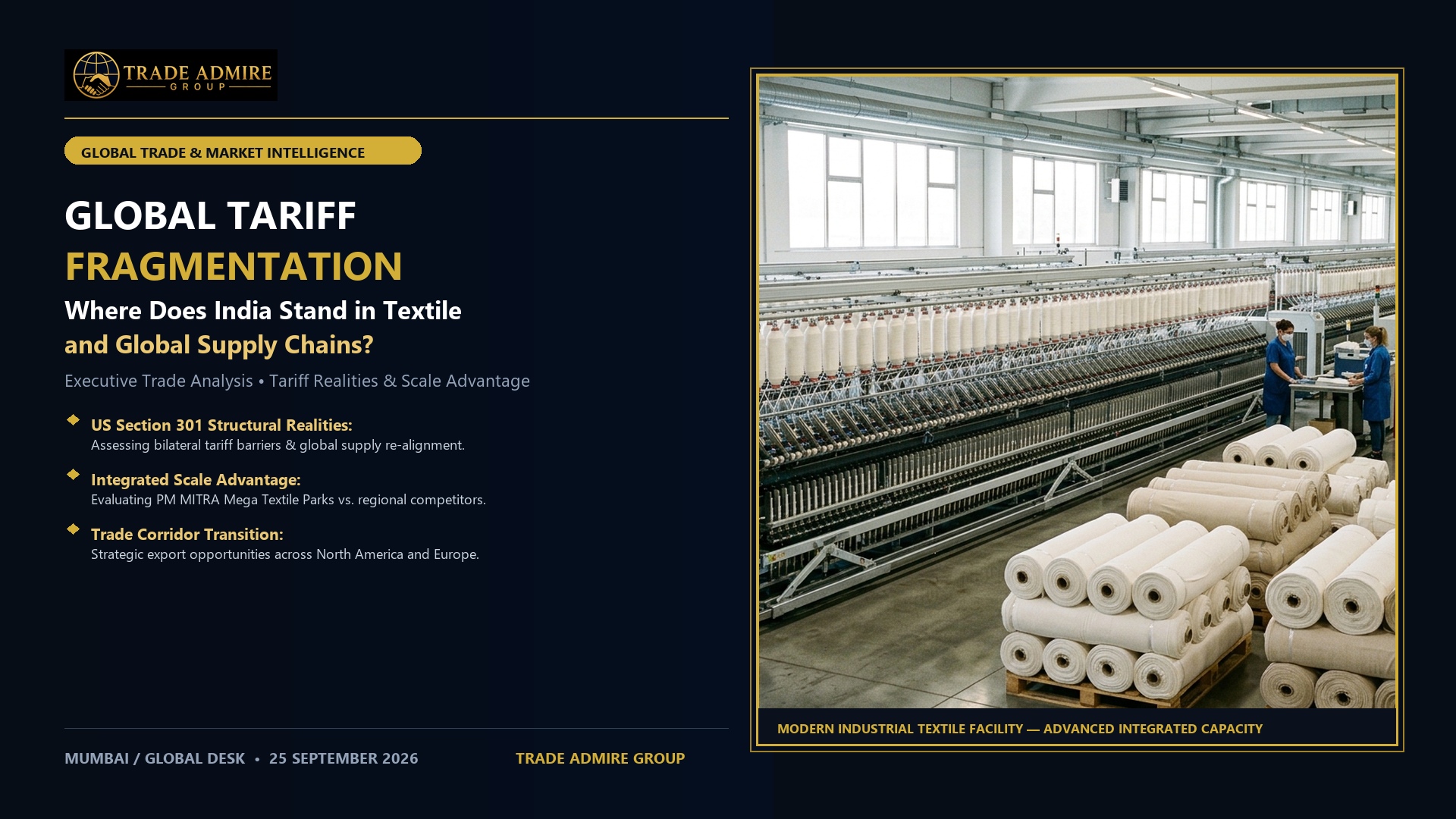
1. A New Phase in Global Trade
MUMBAI / GLOBAL DESK, 25 September 2026: Global trade is entering a more complex phase. Tariffs, industrial policy, geopolitical tensions, supply-chain diversification, regulatory requirements and strategic sourcing decisions are increasingly influencing where companies manufacture and procure products.
The question is no longer simply: “Where can a product be manufactured at the lowest cost?”
Where can a company secure competitive cost, reliable quality, predictable lead times, regulatory compliance and supply-chain resilience at the same time?
This shift is particularly relevant to textiles and manufacturing. On 11 March 2026, the United States Trade Representative (USTR) initiated Section 301 investigations into structural excess capacity and production across multiple economies, including China, India, Bangladesh and Vietnam. This indicates that the global manufacturing environment is being evaluated not only through bilateral tariff structures but also through broader questions of industrial capacity, production structures and trade competitiveness.
Modern Sourcing Calculus:Tariff Exposure + Cost + Quality + Lead Time + Compliance + Resilience
However, diversification does not automatically mean replacing one manufacturing country with another. The opportunity will depend on the ability of individual manufacturing ecosystems to meet increasingly complex buyer requirements.
2. Competitor Reality Check
Bangladesh: Under Pressure, but Not a Manufacturing Collapse
Bangladesh remains one of the world’s important apparel manufacturing and export hubs. According to the World Bank’s Bangladesh Development Update, Bangladesh’s economy is estimated to have grown by approximately 3.9% in FY2026, while the country’s non-performing loan ratio reached 30.6% in December 2025. Ready-made garments remain an important pillar of Bangladesh’s export economy and employment structure.
Therefore, the current environment should not be interpreted as a simple “Bangladesh is losing manufacturing” story. The more relevant question is whether global buyers will diversify a portion of their sourcing while maintaining relationships with established suppliers. This creates a potential China + Bangladesh + India + Vietnam diversification model rather than an immediate one-country replacement model.
Tariff Context: Under the U.S.-Bangladesh trade framework, Bangladesh faces a 19% reciprocal tariff, while specified products identified under Annex III receive a zero reciprocal tariff treatment. Headline tariff rates alone do not determine sourcing decisions. Product-specific treatment, exemptions, compliance requirements, production capability and commercial economics also matter.
3. China: Diversification Without Losing Structural Importance
China continues to possess extraordinary manufacturing depth across raw materials, components, machinery, processing, logistics and supplier networks. Consequently, global companies are increasingly exploring “China + Diversification” strategies rather than assuming an immediate departure from China. The objective is often to create additional manufacturing and sourcing nodes while retaining access to China’s established industrial ecosystem.
For India, this creates a distinct opportunity: India does not necessarily need to replace China. It can potentially become a credible and important Core Node within a diversified global manufacturing architecture.
4. India: Opportunity, but No Exemption
India possesses prominent structural advantages:
- Large domestic consumption market
- Major global cotton production base
- Extensive and skilled manufacturing labour pool
- Established textile clusters across Tamil Nadu, Gujarat, Maharashtra and Punjab
- Expanding logistics infrastructure and port connectivity
- Government-supported manufacturing programmes including PM MITRA
However, India is not outside the scope of global trade scrutiny. India was also included in the USTR Section 301 investigation concerning structural excess capacity and production. This means India’s opportunity should not be interpreted as an automatic benefit from difficulties faced by other manufacturing economies. The opportunity depends on India’s ability to provide a credible, scalable and integrated manufacturing base capable of meeting international buyer requirements.
5. India Textile Capability Matrix
| Capability | India Position |
|---|---|
| Raw Material | Strong cotton base and established textile raw-material ecosystem |
| Domestic Market | Large and diversified consumption base |
| Manufacturing | Established textile and apparel clusters with expanding capacity |
| Technology | Growing capability, although technology depth varies by segment |
| Product Mix | Strong cotton base with opportunities to expand MMF and value-added products |
| Market Access | Trade agreements with UAE, Australia and UK provide expanding market access; concluded India-EU FTA creates additional future market-access potential subject to entry into force |
| Infrastructure | PM MITRA textile parks (7 mega sites) and PLI-linked manufacturing initiatives support integrated ecosystem development |
India’s challenge is therefore not the absence of manufacturing capability. The challenge is integration, scale, speed, consistency and international compliance.
6. The Textile Mix: Where the Structural Gap Appears
India’s Economic Survey 2025-2026 provides an important empirical perspective on textile export composition:
- Ready-Made Garments (RMG): 42.7%
- Cotton Textiles: 32.8%
- Man-Made Fibre (MMF) Textiles: 14.1%
This highlights a critical structural issue: Global textile demand is increasingly dominated by man-made fibres, technical textiles, performance materials and blended products. Therefore, India’s long-term opportunity is not simply to increase cotton-based exports. It must rapidly scale MMF capability, technical textiles, value-added manufacturing, integrated processing, design, and international compliance systems. The objective must be moving from manufacturing capacity to manufacturing depth.
7. Potential Commercial Scenarios for the Next 6 to 12 Months
Analytical assessments based on verified data available as of 25 September 2026.
Scenario A: Incremental Sourcing Diversification
Global buyers may gradually increase sourcing allocations from India as part of broader supply-chain de-risking. However, suppliers will need to demonstrate consistent quality, predictable lead times, international certifications, transparent compliance, competitive pricing, and production scalability. The opportunity will favour suppliers that can reduce buyer risk rather than merely compete on nominal price.
Scenario B: Growth in Value-Added Textiles
India could capture higher market share across technical textiles, MMF blends, functional fabrics, and performance apparel. This transition reduces systemic vulnerability to raw cotton harvest cycles and traditional commodity-price swings.
Scenario C: Compliance-Led Sourcing
Compliance is emerging as the ultimate sourcing differentiator. Global procurement heads are under intense scrutiny regarding forced-labour risks, environmental governance, and full supply-chain traceability. This transforms the fundamental procurement question from “Who can manufacture this product?” to “Who can provide a competitive, compliant and lower-risk supply?”
8. India’s Manufacturing Opportunity: 7 Strategic Pillars
- 1. Manufacturing Scale: Developing larger, fully integrated manufacturing complexes capable of processing large-scale multinational volume orders without production bottlenecks.
- 2. Product Diversification: Accelerating capital expenditure toward MMF, technical textiles, and engineered fabrics to eliminate single-material exposure.
- 3. Supply-Chain Integration: Seamlessly connecting raw yarn, processing, finishing, testing, and multi-modal logistics within single industrial corridors.
- 4. Compliance Infrastructure: Institutionalizing social, environmental, and labour compliance as a core operating capability rather than an afterthought.
- 5. Speed and Reliability: Compressing order-to-shipment lead times and eliminating port clearance latency to match Southeast Asian benchmarks.
- 6. Market Connectivity: Capitalizing on executed free trade agreements (UAE CEPA, Australia ECTA, UK CETA) to build diversified buyer networks.
- 7. Strategic Intelligence: Deploying real-time monitoring of tariff schedules, non-tariff trade barriers, and geopolitical realignments.
Sustainable competitive advantage will belong to ecosystems that master: Cost + Capability + Compliance + Capacity + Connectivity.
9. Trade Admire Group Executive Perspective
Trade Admire Group views the current global trade environment not simply as a tariff dispute, but as an ecosystem restructuring phenomenon. The reallocation of global manufacturing volume operates along a multi-variable chain:
This means India’s opportunity must be appraised holistically. Competitive headline labour costs quickly evaporate if fabric consistency is erratic, lead times are protracted, or ESG compliance is opaque. Conversely, an integrated ecosystem delivering cost, speed, compliance, and resilience becomes an indispensable partner to Fortune 500 procurement desks.
10. Strategic Synthesis
- Cost: Can Indian mills sustain razor-sharp commercial competitiveness amidst rising energy and input volatility?
- Capability: Can Indian apparel manufacturers shift upmarket into complex, technical and blended garments?
- Compliance: Can suppliers satisfy stringent international ESG, labour transparency, and carbon accounting mandates?
- Capacity: Can manufacturing clusters absorb mega-scale international purchase orders without delivery degradation?
- Connectivity: Can Indian supply chains integrate seamlessly into global freight, digital trade rails, and cross-border trade finance?
11. Trade Outlook & Conclusion
Based on verified institutional data as of 25 September 2026, India stands at a pivotal historical junction. Global supply-chain diversification is no longer an intellectual exercise; it is an operational imperative driven by geopolitical friction and regulatory enforcement.
However, opportunity does not automatically translate into market share. The competitive outcome is not predetermined. India’s long-term standing will depend on the speed and discipline with which it builds manufacturing depth combining Cost, Quality, Speed, Compliance, and Resilience.
Key Economic & Trade Indicators
| Indicator | Position / Verified Value |
|---|---|
| Bangladesh Reciprocal Tariff | 19% |
| Bangladesh FY2026 Growth (World Bank) | 3.9% |
| Bangladesh NPL Ratio (Dec 2025) | 30.6% |
| India RMG Share of Textile Exports | 42.7% |
| India Cotton Textiles Share | 32.8% |
| India MMF Textiles Share | 14.1% |
| PM MITRA Mega Textile Park Sites | 7 Sites |
Primary Sources & References
- Office of the United States Trade Representative (USTR): Section 301 Investigations into Structural Excess Capacity and Production (March 2026).
- United States Trade Representative: U.S.-Bangladesh Trade Framework and Reciprocal Tariff Provisions.
- World Bank Group: Bangladesh Development Update (Spring 2026 Edition).
- Government of India, Ministry of Finance: Economic Survey 2025-2026.
- USDA Foreign Agricultural Service: India Cotton and Textile Sector Annual Baseline.
- Press Information Bureau (PIB), Government of India: PM MITRA Mega Investment Textile Parks.
- United Kingdom Department for Business and Trade: India-UK Comprehensive Economic and Trade Agreement (CETA).
- Ministry of Commerce and Industry, Government of India: India-EU Free Trade Negotiations.
Related Network Coverage & Intelligence Dispatches
- PressGlob Trade Desk: Textile stocks rally up to 10%: Raymond, Gokaldas Exports, other stocks rebound after Trump tariff-triggered selloff (22 September 2026)
- PressGlob Geopolitics: Is Trump’s 100% tariff threat on India “leverage to push through a trade deal”? Expert weighs in (24 September 2026)
- PressGlob Global Trade Monitor: Global Supply Chain Realignment: Evaluating US Section 301 Tariffs and Southeast Asian Transshipment Dispatches (23 September 2026)
- PressGlob Policy & Enterprise: Trade Admire Group Begins Development of PressGlob as Part of Its Global Digital Information Infrastructure (GDII) (22 September 2026)
- Bilateral Trade Network: Trade Admire Group Engages with India-US Business Ecosystem at IACC National Convention 2026 (25 August 2026)
- Cross-Border Advisory Desk: Trade Admire Group Enters Cross-Border Partnership Dialogue with U.S. Network to Explore Strategic Collaboration (21 August 2026)
- Industrial Infrastructure & Corridors: Vibrant Gujarat Global Summit 2027 Curtain-Raiser: Trade Admire Group Engages on Industrial Policy, Supply Chains & Sustainable Trade Corridors (11 September 2026)
- Tatvonic Intelligence Systems: Tatvonic Systems: Predictive Trade Flow Modelling & Integrated Manufacturing Scale Analysis (September 2026)
Institutional Context & About Trade Admire Group
The Strategic Synthesis, Sector Matrix and Sourcing Framework presented in this analysis are structured by Tatvonic Intelligence Systems to deliver C-suite commercial clarity. Trade Admire Group is a global merchant enterprise and trade intelligence advisory headquartered in Mumbai, India, operating across international agro-commodities, industrial manufacturing, and cross-border strategic advisory.
Editorial & Legal Notice: This article is intended for informational and analytical purposes only. It does not constitute investment advice, legal advice, tax advice, financial advice or commercial solicitation. Trade policies, tariffs, regulations, market conditions and international agreements may change after the stated data cut-off. Readers should independently verify current conditions before making commercial decisions. © 2026 Trade Admire Group. All rights reserved.